Saturday, August 13, 2011

We did it once...

Pimp our highway, please | Opinion | Creative Loafing Atlanta

I'm astounded that at the same time we face the imminent catastrophic failure of a regional transit proposal, Central Atlanta Progress and the Midtown Alliance are talking about, not functional improvements, but redecorating the downtown connector.

One reader takes it the logical step further and suggests "Roof it over from 17th Street to the Grady curve. Make it a linear park." Why, that's absurd, it... wait.

We did it once. Underground Atlanta is only part of a much larger area one story below downtown Atlanta's current street level. Long-time residents still call the area "the viaduct". It stretches from GSU and the Capitol west to CNN Center and the World Congress Center. Railroads became such a large part of the city's economy that multiple overpasses were built for vehicular and pedestrian traffic. An architect named Haralson Bleckley had the outrageous idea to rebuild the iron bridges in concrete and connect them with a linear mall.

Hmmm.

LATER: Okay, "catastrophic failure" may have been unnecessarily hyperbolic. "Failed to reach a consensus" seemed inadequate.

Fulton says "we didn't ignore Dekalb, see, here's Clifton Corridor", and DeKalb says "I-20 rail line or no deal", and Clayton says "Hello, remember us?" and Henry says "Please, forget us", and Fayette says "We don't even have interstates here, let alone rail transit, and glad of it!" I had such high hopes for a committee on which other areas (read "south of I-20") were represented.

I underestimated the intensity with which the doughnut hates the hole.

Thursday, August 11, 2011

The Straight Dope: Whatever happened to the "paperless office"?

Well, it's a complicated question, but the ultimate answer is, we're getting there.

The Straight Dope: Whatever happened to the "paperless office"?
A more persuasive explanation [for why the paperless office has failed to materialize], however, is that computers suck. Paper is cheap and adaptable, and, equally important, almost always works. If you’re an office drone scrambling to get a last-minute report out, one disaster you're not living in fear of is the Blue Sheet of Death. Computers, in contrast, make politicians look reliable. And let’s not forget premature high-tech obsolescence.
Having worked in the report-distribution end of the computer room, my own theory is that we just plain feel better if we have our customer data nearby in hard copy. In the old days, replacing a cabinet full of data tables was something you only did every other month or so. With handy, inexpensive computer printers that could print documents far faster than anyone could ever read them, even a small office could generate thousands of pages of new, customized reference data every day.

Monday, August 08, 2011

Traffic of the future

So they want to put one of these on Ashford-Dunwoody road?

This image of a typical diverging diamond actually comes from
the Missouri Department of Transportation, but I found it at blog.cleveland.com.

‘Diamond' interchange coming to I-285 in Dunwoody | ajc.com

I had to go see both the Wikipedia entry for diverging diamond interchanges and a YouTube video of a diverging diamond visualization before I got a feel for exactly how this would work. If you've exited GA 400 at Lenox Road, or Peachtree Industrial at Tilly Mill or Jimmy Carter Boulevard, you may have a head start. At those intersections, when you enter or exit the limited-access highway, LEDs embedded in the street show you that you drive a significant distance on the "wrong" side of the street. I consider those intersections "training wheels" for this, where even surface traffic traverses the entire under/overpass on the "wrong" side. 

It's almost guaranteed that for us Atlanta drivers, our first reaction is going to be that this can't possibly work. Look how much trouble we have with those "wrong side" HOV ramps at I-75 and Northside Drive.

But this is a completely different perspective on what an intersection has to accomplish. Sure, a traditional cloverleaf would be ideal, easier to visualize. But you need a lot of room on all sides to build one of those, and you're certainly not going to find that at Ashford-Dunwoody road. This, you can do without even rebuilding the bridge. And I sure can't think of an intersection anywhere in Atlanta that needs help worse than this one.

And Springfield, MO certainly seems happy with theirs.

I can't remember the last time I was excited about a highway intersection. I can't wait to try this thing!

Where are all the librarians?

New Assignments for APS Media Specialists | Cascade Patch
Students who have gotten used to seeing the faces of familiar media specialists in their school's libraries may be disappointed when they return to school today. That's because some media specialists have been reassigned because of the Atlanta Public Schools' cheating scandal.
Many librarians are also fully certified as classroom teachers: In fact, many librarians are semi-retired classroom teachers who wanted to return to the school, but not to the day-to-day teaching grind. But with 178 educators missing in action, Atlanta Public Schools can't be choosy. The librarians aren't happy about it: If for no other reason, this surprise was revealed to them just last week.

Those of you who know that I'm on pretty good terms with one media specialist librarian (they voted that they want to be called "librarians" and that works for me) need not be concerned. She doesn't have the certifications to be a classroom teacher. But she is still affected by this move: Since there aren't enough librarians to go around, she's now part-time at two schools rather than full-time at one.

I haven't been following the blow-by-blow of APS news coverage here the way I used to, and probably won't in the future. One, a quick Google news search for "Atlanta Public Schools" will turn up a ton of it, and two, well, there are still things I daren't say.

But other people will.

Sunday, August 07, 2011

Taylor's First Law


I've had a theory for several years now, but I haven't been able to articulate it to my own satisfaction -- until now. I had to hear educators describe what they do, not as "teaching" but as "moving" students, from one reading level to the next, from one grade to the next, from one school to the next. And they do, or at least the teachers do whom I happen to be in a position to overhear, and when one says it the rest know immediately what is meant.

...and it came to me.

You're jealous of what the rest of us would refer to as "real" scientists. You want to think that education is a hard science like, say, physics. You want education to be Newtonian.

Sir Isaac Newton's First Law of Motion (loosely expressed and simplified to an Earthly environment where gravity and friction are assumed and constant) is this: An object at rest tends to remain at rest, unless acted upon by an outside force. Force generates motion. Apply enough force to an object and it moves.

Since I'm formulating this theory, I'll call it:
Taylor's First Law of Education
An inert mind tends to remain inert, unless acted upon by an intellectual force. 
You encounter a dozen or two inert minds in your class (I wish that brutal description weren't accurate); You apply intellectual force to these minds, in hopes of generating academic movement. Sometimes it works. *

In lieu of the newtonian "foot-pound" with which to measure physical force, I propose the "thought-grade" with which to measure academic force, or influence. You apply, say, .006 thought-grades (6 milli-thought-grades, or 6 mtg) of intellect to each student each day, and at the end of 180 school days, the student has received one complete thought-grade of influence, and therefore moves one grade upward.

Actually, that's 1.08 thought-grades, maybe 13 extra days, but there's not a teacher alive who wouldn't grant the existence of intellectual friction. Everyone knows, for instance, that the week before Christmas break is a waste of time.
_____
*   It would be a perfect theory if we understood why it only works "sometimes." That's the difference between Physics and Psychology, and why education is not, in fact, a newtonian science.

Wednesday, August 03, 2011

The New Fort Mac

Fort McPherson redevelopment could change southwest Atlanta -- for better or worse | News Feature | News & Views | Creative Loafing Atlanta
But some local community members and advocacy groups say the authority's plan is myopic and treats the property as a stand-alone project, rather than a site that needs to become integrated with the rest of the city. What's more, they think the authority has overlooked the role surrounding neighborhoods can play in determining what Fort Mac should become.
Have you taken a look at the surrounding neighborhoods lately?

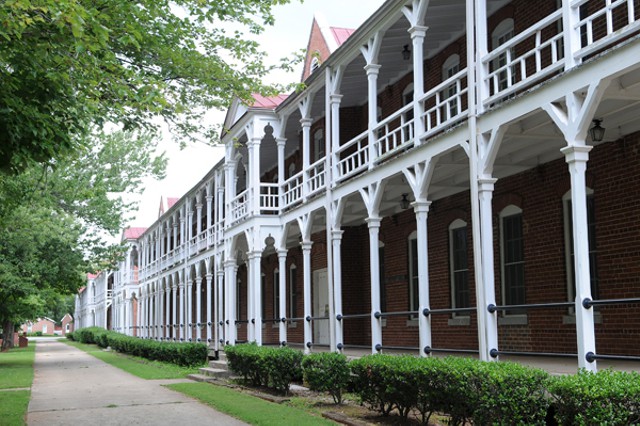
Here's what Fort Mac looks like now:


Here's what Oakland City looks like now:


You tell me which way you think influence is likely to flow. Insensitive and bigoted as it sounds, it's hard to imagine that opening the Fort Mac front gate is going to do Fort Mac any favors.

Wednesday, July 13, 2011

Wow, what a busy month it's been

And thank goodness the AJC has been paying more attention than I have. I was pretty well convinced nothing of any consequence would happen over the summer. I could not have been more wrong.

One of the big stories, as you'll recall, was the ongoing investigation into widespread cheating (by administrators, not by students) on the CRCT. That's the Criterion-Referenced Competency Test: In addition to students being required to pass it in order to advance to the next level at key grades, it is also used to allocate resources for additional help for students and schools in need. It's no secret to anyone within Atlanta Public Schools that someone's reputation rides on being able to show consistent and impressive improvement from year to year -- whether the students actually are improving or not.

The other big story, which is actually unrelated to the CRCT scandal, is the fact that we have a contentious school board. They get along so poorly that AdvancED has placed Atlanta Public Schools' on probation, at risk of losing its accreditation. (This eventuality would cost APS grant money and make it harder for students to be accepted in colleges.)

So what's been going on?
Let's see, the chairman of the school board resigned. Initially he was to remain on the board, but he has since resigned completely. A new chair has been named.
The superintendent has retired, and the search for a successor continues.
We have an interim superintendent, God help him. Although this is actually a golden opportunity: An appointee with no ambition to keep the job permanently can afford to step on some political toes, which he'll almost certainly have to do to get APS in order.

A former APS official said she was ordered to destroy reports that would confirm "systematic" cheating. Her boss just resigned.

June 30: Investigators delivered a 800-page report to the Governor, which (after taking the weekend to read it and let certain key parties know what it would say) he released to the media on July 5. The report names names, and it's not pretty. "Interim Atlanta schools superintendent Erroll Davis said in a news conference later Tuesday that those responsible for the cheating will 'not be put in front of children again.' " (Good to hear, but most of them haven't been in front of children for years, discounting the occasional honors program. They're ensconced in administrative positions, safely separated from the little darlings. But see below.)

Investigation into APS cheating finds unethical behavior across every level: "Area superintendents silenced whistle-blowers and rewarded subordinates who met academic goals by any means possible." If you really want to know how many people cheated school-by-school, it's here and here.

Retiring superintendent Beverly Hall still says she didn't know this was going on, but she nonetheless accepts ultimate responsibility. The report doesn't specifically say she did know, but it does say she should have known. It may cost Hall her 2009 Superintendent of the Year award. (Well, duh.) And parents in Dallas, TX are demanding that her ex-deputy superintendent lose her new job as superintendent of DeSoto Independent School District.

The search for a new permanent superintendent is on hold while the interim superintendent "began Thursday to dismantle former school chief Beverly Hall's administration". He has removed four deputy superintendents designated as "School Reform Team Executive Directors". (APS divides its elementary and middle schools geographically into School Reform Teams, referred to as SRTs. There is a fifth SRT director who oversees all of the city's high schools. So far, no high schools have been implicated in the CRCT investigations.)

Other than that, not much, what's new with you?

Monday, May 30, 2011

"OK, you win"

APS board chair agrees to step down | ajc.com
Atlanta school board Chairman Khaatim Sherrer El agreed Monday to step down from leadership.
El and other members sought assurances that the move would unify the board and assure city leaders of its intent to win favor with the Southern Association of Colleges and Schools (SACS), which put the district on probation.
I'm not prepared to say Mr El is correct in all things, but if the charge is "the board is contentious" and the response is "one person changes", I don't understand how that can possibly be enough. That would imply that Mr El is not merely a problem, not merely the biggest problem, but the only problem.

Oh, and while we're at it:

Atlanta superintendent acknowledges cheating | ajc.com
A month before retiring as Atlanta’s schools superintendent, Beverly Hall finally acknowledged this week that educators cheated to help students pass state-mandated achievement tests. And, she said, the findings of a criminal investigation into the matter will be “alarming.”
In the interests of accuracy, I should note she didn't say it would be "surprising". And I should also mention that if she'd said this a year ago, APS would not now be in the jam it's in. They'd still be in a jam, just a different, more reparable jam. And folks might, you know, trust them to fix it.

As it is, though, it just makes it look like Job One at 130 Trinity is to keep the wagons circled.

Monday, May 16, 2011

What does a librarian do?

Seth's Blog: The future of the library

I like Seth Godin, but...

Before Gutenberg, a book cost about as much as a small house. As a result, only kings and bishops could afford to own a book of their own.
No, neither kings nor bishops owned books. Why would a king want one? He couldn't read. It's only many decades after Gutenberg that the concept of "public literacy" gained any meaning at all.

Industrialists (particularly Andrew Carnegie) funded the modern American library. The idea was that in a pre-electronic media age, the working man needed to be both entertained and slightly educated.
Slightly educated? Slightly educated? Carnegie weeps.

Your kids need a place with shared encyclopedias and plenty of fun books...
Is that what you think a library is for? Carnegie wails.

Which was all great, until now. Want to watch a movie? Netflix is a better librarian...
You were talking about libraries, not movies. Carnegie gnashes his teeth.

Wikipedia and the huge databanks of information have basically eliminated the library as the best resource for anyone doing amateur research (grade school, middle school, even undergrad).
Oh, so that's where you were going. Why didn't you say so to begin with?

In any case, it's not so. Wikipedia didn't eliminate the library: Its creators simply responded to a need for a skill that students were no longer being taught. The ready reference librarians never went away: They are still there.

The library is still "the best resource for anyone doing amateur research". It's just that few people really do that any more, absent some classroom requirement. For decades, schools have taught and other media (okay, I'll say it: "television") have reinforced that only intellectuals read. Alphabetical order? Bibliographic citation? Scientific method? These are for elitists only, of no practical value to such as us. Anything worth knowing can be understood in ten words or less. (Never mind that that sentence is eleven words.)

They need a librarian more than ever (to figure out creative ways to find and use data). They need a library not at all.
The librarian was always the most valuable asset to be found in a library. Without her (so sue me: the vast majority of them are women), it's just a box of books. Even if the patron doesn't deal with the librarian personally, he benefits from her judgement in the criteria by which the collection is selected and maintained. She's an editor who culls the flawed and nonsensical, and recommends the more reliable sources, most likely to actually enrich your experience. (This is a function with which Wikipedia still struggles.)

Librarians that are arguing and lobbying for clever ebook lending solutions are completely missing the point.
Oh, really, Seth, that's a controversy you don't want to even brush up against in an article as short as this one. Publishers have always distrusted libraries (every book borrowed is a book not sold, they say, and from whence will the next book come if the previous book isn't profitable?), and ebooks embody everything they dislike about libraries. The librarian's goal remains unchanged: To get the information into the hands of the person who wants it. Librarians have no particular desire for "clever ebook lending solutions", they just want the damn books and have to compromise with the publishers who insist that access to those books be limited.

But, as I said, this is a discussion for another day.

The next library is...
The library today already is all of the things you want "the next library" to be.

But I think the next time you utter the phrase "dead paper", some librarian is going to grab the nearest, most bricklike stack of "dead paper" and throw it at you.

Monday, March 28, 2011

Whose 'Noles?

More universities haggling with high schools over trademarks

High schools that share logos with universities may soon find themselves shopping for new mascots.
Florida State, which last week reached a settlement with the Rockdale County Board of Education prohibiting Salem High and Memorial Middle from using the Seminoles logo, isn't the only university aggressively protecting its trademark.
The Atlanta-based Collegiate Licensing Company, acting on behalf of the University of Florida, sent a similar letter to two Palm Beach, Fla., high schools last fall. And the University of Mississippi forced a Tennessee high school to drop its mascot of 50 years, Colonel Reb, due to trademark infringement claims.
I've seen plenty of high school mascots and logos that were copies of collegiate or professional teams' logos. I, like most of you (I'm guessing), assumed the schools had actually asked. I should have known better.

The likely response is "but they're schools".
"It was a matter of principle for me," said [Rockdale] board vice chairwoman Jean Yontz, who cast one of two dissenting votes. "We're not making money off the the Seminoles, but now we're going to have to take money away from education to pay for this."
Making money is beside the point. If a logo has value to the high school, it seems disingenuous to claim that it doesn't have any to the college. In the eyes of the law (which must mean something), co-opting someone else's intellectual property is theft. It the intellectual property owner doesn't protect its right to control how its property is used, it loses that right and the material becomes public domain. The courts have been consistent over this point for decades.

This weekend at APS

What, more problems?

Beverly Hall closely tracked CRCT results
...E-mails, memos and other documents recently obtained by The Atlanta Journal-Constitution provide the most detailed look to date at the intensity with which [Atlanta Public Schools' Superintendent Beverly] Hall followed the yearly CRCT results. She parsed scores in detailed exchanges with district researchers. She praised subordinates whose numbers improved. She kept business leaders and other supporters apprised of successes.
Nothing in the e-mails and other material suggests that Hall, Atlanta’s superintendent since 1999, ordered anyone to tamper with test papers or to behave illegally or unethically to achieve certain outcomes. How the district achieved its impressive 2009 scores is at the center of two criminal investigations.
I'm assuming everyone has noticed that reports keep leaning heavily on the item, paraphrased differently from story to story, that nobody is saying Hall knew. Neither am I -- but if she was qualified to sit in that chair, she must have suspected. The best possible spin that can be put on it is that she was too eager to believe unbelievable numbers. Villain or victim, though, she shouldn't become the CRCT scapegoat. There's plenty of clear deceptive intent to go around.

And now what?

APS underfunded its pension plan
The district has underfunded its pension for custodians, bus drivers and cooks by more than a half-billion dollars.
APS has the worst underfunding of any large public pension plan in the state, according to a recent state audit. While it is generally agreed that, at any given time, a pension plan should contain 80 percent to 90 percent of the money it is obligated to pay out, APS has assets to cover just 17.4 percent of its pension promises.
“It’s something that dates from long ago,” ...said Chuck Burbridge, the district’s chief financial officer.
How long? When did it begin? Nobody wants to say.
Most teachers are in a separate state-run plan that is much better-funded. 
Oh, well, then.

Friday, March 25, 2011

This week at APS

APS teachers’ contracts held amid cheating scandal
Atlanta Public Schools notified hundreds of educators last week that their future employment is uncertain, reigniting protests from state investigators who have repeatedly complained about intimidation of potential witnesses in their wide-ranging criminal inquiry into test tampering.
The investigators, appointed to examine cheating in Atlanta after the state found high numbers of suspicious erasures on standardized tests in 2009, told the school district Friday to immediately withdraw letters telling about 450 teachers their contract renewals are on hold.
Anybody besides me remember an old Pete Seeger song about being "Waist Deep in the Big Muddy"? Here in the Real World, of course, it's illegal to fire people for whistleblowing. I'm eager to hear why APS thinks this should not be so for them.

Reed wants to appoint some school board members
Atlanta Mayor Kasim Reed for the first time Monday raised the possibility he might try to seek special power to appoint city school board members, as he seeks to speed reforms mandated by the city system's accrediting agency.
I don't think the mayor actually intends to do this, but it must be frustrating dealing with the APS Board.

Sunday, March 20, 2011

APS Ketchup

If we're not careful, the CRCT investigation is going to get misplaced.

Atlanta school board sets path to fix accreditation
Atlanta school board members voted Monday night to accept an accreditation report that put the school system on probation.

APS Put on Probation; Hall Vows to 'Secure' Status

SACS says the Atlanta school system must take six actions to avoid losing accreditation:
  • Develop and implement a long-term plan to communication with and engage stakeholders in the work of the district and to regain the trust of parents and students.
  • Secure and actively use the services of a trained, impartial mediator who will work with board members to resolve communication, operational and personal issues that are impeding the effectiveness of the governing body.
  • Ensure that the actions and behavior of all board members are aligned with board policies, especially those related to ethics and chain of command.
  • Review and refine policies to achieve the mission to educate students.
  • Develop and implement a process for selecting a new superintendent that is transparent and engages public participation. The final choice of superintendent should be determined by more than a simple majority of the board.
  • Work with the state of Georgia to address inconsistencies between the state charter for the school board and system policies.

Schools spent millions on now-optional new math
Some school systems invested millions of dollars in the new and soon-to-be-optional integrated math curriculum for high schools, a survey of metro districts by The Atlanta Journal-Constitution showed.

APS board members may pursue independent counsel
The motivation for board members Nancy Meister, Yolanda Johnson and Brenda Muhammad is unclear.

Hall's contract may face outside review
City school board Chairman Khaatim Sherrer El brought up the review in the waning minutes of a three-hour "emergency special" meeting, most of which was spent by members behind closed doors. He backtracked immediately afterward, however, as other members crowded around him to protest that the board neither publicly discussed nor reached any sort of consensus on the issue.

APS official believes she’s a scapegoat
The high-level Atlanta Public Schools official accused of telling principals to send "go to hell" memos to state investigators thinks she has become a scapegoat in a systemwide cheating scandal. ...[SRT-3 supervisor Tamara] Cotman was referring to an anonymous letter, sent to the school district in December, that alleged she discouraged a group of principals from cooperating with a criminal investigation of cheating on the 2009 Criterion-Referenced Competency Test. ...She said she did pass out blank "go to hell" sheets — but did not speak disparagingly of state investigators. She said she was right to encourage principals to vent their frustrations — but did not single out the investigators for condemnation.

Atlanta school board hires professional mediator

Mistake costs Atlanta schools $48 million, delays projects
An unintentional paperwork error by the Fulton County school system will cost Atlanta Public Schools $48 million and force the city to delay several school construction projects, in some cases indefinitely. Fulton officials didn't file a form that accurately reflected the enrollments of the city and county school systems, resulting in an overpayment to Atlanta from a 1-percent sales tax used for school capital needs.

ATL school board appoints community panel
The Atlanta school board has formed a community engagement committee to help gather ideas and offer feedback about how it communicates and engages the public. The move aims to help the board meet a mandate from the system's accrediting agency.

APS faces more than $30 million in 2012 cutbacks
Atlanta Public Schools expect budget cutbacks of more than $30 million next school year, resulting in cost-cutting moves that likely include another increase in class sizes (mainly in middle schools), a continued employee pay freeze and two days of involuntarily furloughs. However, officials said they did not anticipate layoffs or a property tax increase.

Group calls for APS board chairman to relinquish leadership role
An Atlanta parents group organized in the wake of the city system being put on probation said Friday that school board member Khaatim Sherrer El should step down in his role as board chairman and that new officers should be elected. The group, Step Up or Step Down, was reacting to e-mails published Thursday by The Atlanta Journal-Constitution's "Get Schooled" blog in which a member accused El of making an offensive gesture at her, among other issues. El declined comment on the announcement. The Southern Association of Colleges and Schools put Atlanta on probation in January for reasons related entirely to the board's governance.

See also Step Up Or Step Down's Facebook page.

Wednesday, February 23, 2011

APS court-ordered to blink

Atlanta school system calls off its investigation | ajc.com
State investigators have won their fight with Atlanta Public Schools over whether the district should halt its inquiry into inflammatory comments by a high-ranking school official.
Fulton County Judge Doris Downs — and representatives of the district and state investigators — signed a consent order Tuesday in which the district promised to drop its investigation of allegations that Tamara Cotman, a regional superintendent, suggested a dozen principals tell GBI agents to “go to hell.”
So does that mean she goes back to SRT-4 (supervising principals), or she stays relocated to non-supervisory capacity in the "English as a Second Language" unit, or what?

Tuesday, February 22, 2011

What were they supposed to say?

The Descent
Atlanta school district denies trying to obstruct
Lawyers for Atlanta Public Schools have sent state investigators a defiant letter, ratcheting up the tension in an already-strained relationship.

In a three-page letter, sent Friday and obtained by The Atlanta Journal-Constitution, district officials denied obstructing the state’s criminal investigation into test-tampering, as investigators alleged last week. The letter objected to accusations that school officials have for years systematically retaliated against employees who reported cheating on state tests.

The school system also refused to cease its internal inquiry into allegations that a high-ranking district official allegedly advised a dozen principals to tell GBI agents to “go to hell.”
Judge orders APS to halt investigation
A Fulton County judge has ordered Atlanta Public Schools to halt an inquiry involving a high-ranking school official after state investigators accused the district of misleading them, hiding evidence and retaliating against a witness, according to documents filed Monday.

The temporary restraining order — signed by Superior Court Judge Craig Schwall just before 10 p.m. Sunday — provided a sharp answer to the district’s defiant pledge Friday to continue its investigation of Tamara Cotman, a regional superintendent who is accused of commanding principals to tell GBI agents to “go to hell.”

The state investigators, appointed in August to examine evidence of widespread tampering with state tests in Atlanta schools, asked the district last week to stop internal investigations related to cheating. The district refused and the investigators took the matter to court over the weekend.
It is hard to interpret "go to hell" as an expression of wholehearted willing cooperation.

Administrative trivia

022111: Time is on my side, yes it is...I have too many blogs and not enough time to maintain them all. Therefore, I've just merged my comic-book-specific blog, "An Ear--in the Fireplace!", back into this one. Scrolling down to Labels and choosing "comic books" will allow you to see only those incoming posts, although I can't think of any good reason why you would want to.

Why America's taxpayers are enraged


Bates School
Originally uploaded by Larry the Biker
Why America's teachers are enraged - CNN.com
I really shouldn't say anything: I have too many friends who are teachers.
The much-publicized film "Waiting for 'Superman'" made the specious claim that "bad teachers" caused low student test scores. A Newsweek cover last year proposed that the key to saving American education was firing bad teachers.
Yes, I've know how much public school teachers hate "Waiting for 'Superman'". I haven't seen it, so I won't defend it. But isn't it just a bit disingenuous for teachers to claim that they have nothing to do with students' low test scores?

And how can anyone say that it's a bad thing to fire bad teachers? Are they blithely asserting that there are no bad teachers? (I never met a teacher yet who thought so.) That there is no way to tell? (Likewise.)

In every other service career it's expected, in some cases legally required, that there will be some kind of evaluation of job performance. Criteria for success are clearly defined, transparent to the consumers of those services, and publicly available. I can't think of a single reason why teaching should be exempt from this. This is the flip side of desiring more commitment from your students' parents: You have to be able to prove that our children are actually better off spending eight hours a day with you than being home schooled, or even being locked in a cage in the basement.

Sunday, February 20, 2011

Catching up

Here are a couple of news stories about the ongoing investigation of Atlanta Public Schools that I missed the first time around.

Whistle-blowing teachers targeted
Former teacher Sidnye Fells: “It’s just this thing that everyone knows is going on but nobody says anything.... It’s the elephant in the room. If you say anything, you lose your job.”
Education secretary to Atlanta board: Get your act together
Mayor Kasim Reed: “There are times when a mayor needs to be outraged. If I am not outraged, show me the person who should be. If I am not pushing for change and reform, show me the person who should be pushing for it.”
U.S. Education Secretary Arne Duncan: "What you have now, frankly, is you have adults who I think have lost sight of why they’re doing this work. It is what I call adult dysfunction."
Atlanta school board to meet on cheating response
Atlanta school board members will meet Monday with Superintendent Beverly Hall about how she and her staff handled both the system's response to an ongoing state cheating probe and actions by top aides that drew a piercing rebuke last week by investigators.
The meeting follows reports that two high-ranking Atlanta Public Schools officials have over the past several months disparaged the investigation, which involves possible widespread test-tampering in schools during the state's 2009 Criterion-Referenced Competency Test.
It also follows a sharply worded letter sent by the investigators that alleged a pattern of "intimidating, threatening and retaliating" against employees who report cheating or other improprieties.
As you were.

Saturday, February 19, 2011

I'm shocked. Shocked.


AJC | State: Atlanta schools protect those who would intimidate whistleblowers
State investigators have uncovered what they call a pattern of “intimidating, threatening and retaliating” against Atlanta Public Schools employees who report cheating or other improprieties.
Imagine that.

See also Atlanta schools official reassigned pending "go to hell" investigation.
And Another APS official disparages cheating probe.

Wait, I can't let this go.
The “... calling in of the Georgia Bureau of Investigation is what, nothing short of horrific,” [Deputy Supt. Kathy] Augustine said in [the conference call with principals]. “It is extremely denigrating, it is extremely disrespectful, it is... it is just... it is just bizarre.”

...In her e-mailed statement Wednesday, Augustine elaborated: “My reference to “horrific” related specifically to the reaction of many educators to state [GBI] agents who normally investigate felony criminal activity going to schools in the middle of the day to question principals, teachers and staff.”
This says to me that, even now, they don't think they've done anything wrong. No, wait, that's not enough: That they don't think the charges against them are that serious. That even if they had done it, so what? It's not worth calling in the GBI. Anyone would think they were common criminals.

Tuesday, December 21, 2010

Make it so


Reflections [HDR] 
Originally uploaded by sibastiNo
APS suppressed scandal | ajc.com
Atlanta Public Schools officials, including Superintendent Beverly Hall, carried out a broad campaign over two years to suppress mounting allegations of widespread cheating on standardized tests, an investigation by The Atlanta Journal-Constitution has found.

Hall, who built a national reputation on raising urban students’ test scores, worked with top aides and prominent supporters to minimize or conceal evidence that some of the district’s much-vaunted gains were not legitimate.
Read the whole article.
AJC report confirms Perdue decision to probe Atlanta Public Schools | ajc.com
State investigators took over a probe of Atlanta Public Schools in August after Gov. Sonny Perdue said he was concerned the search had been deliberately narrowed.

Monday, his spokesman said that decision appears to have been confirmed after The Atlanta Journal-Constitution reported local officials carried out a broad campaign over two years to suppress mounting allegations of widespread test cheating.

"That's why the state did what it did," Perdue spokesman Bert Brantley said.

The AJC compiled the report using hundreds of documents obtained through the Georgia Open Records Act. It said Atlanta Superintendent Beverly Hall and other system officials exerted far greater influence than previously acknowledged on a local investigation of 58 schools with suspicious test scores.
Looks like they're trying to hang Dr Hall for it. That answer is too easy, and won't address the greater problem.